Category: social networking

Update to Social Media Semi-Blackout Update

So, last night. Went home from work. Had a nice conversation and chill with my wife as we discussed some stuff with the sitting next to me.

Then took the dog for a walk.

Then had dinner and helped clean up as we talked.

Then we watched a Rush concert on TV for the rest of the evening. I checked social media on my computer for about 30 minutes, put it away, and spent the rest of the night finishing the book I was reading. That’s it. No more social media.

I am finding, already, that I want to check social media less and less.

Slowing breaking the chains.

Using Mastodon Social Media

Here are a few quick notes to help some friends understand Mastodon as a replacement for Twitter.

  • You know how you can get text messages on your phone from people who have different kinds of phones and use different cellular providers? That’s how Mastodon works. People run lots of Mastodon servers. Some are big, some are small, but they all speak the same language. You can sign up on one server and still follow and interact with people on other servers.
  • Finding the server you want to start on may be the most difficult part right now. I found one related to roleplaying games. There are hundreds of them, but only a few show up on the Mastodon Social website.
  • If the server you are on decides to shut down, you can easily transfer your whole Mastodon account and everything to another server. It it built into the system.
  • Different servers have different rules. No one person owns all the servers. No one can buy Mastodon.
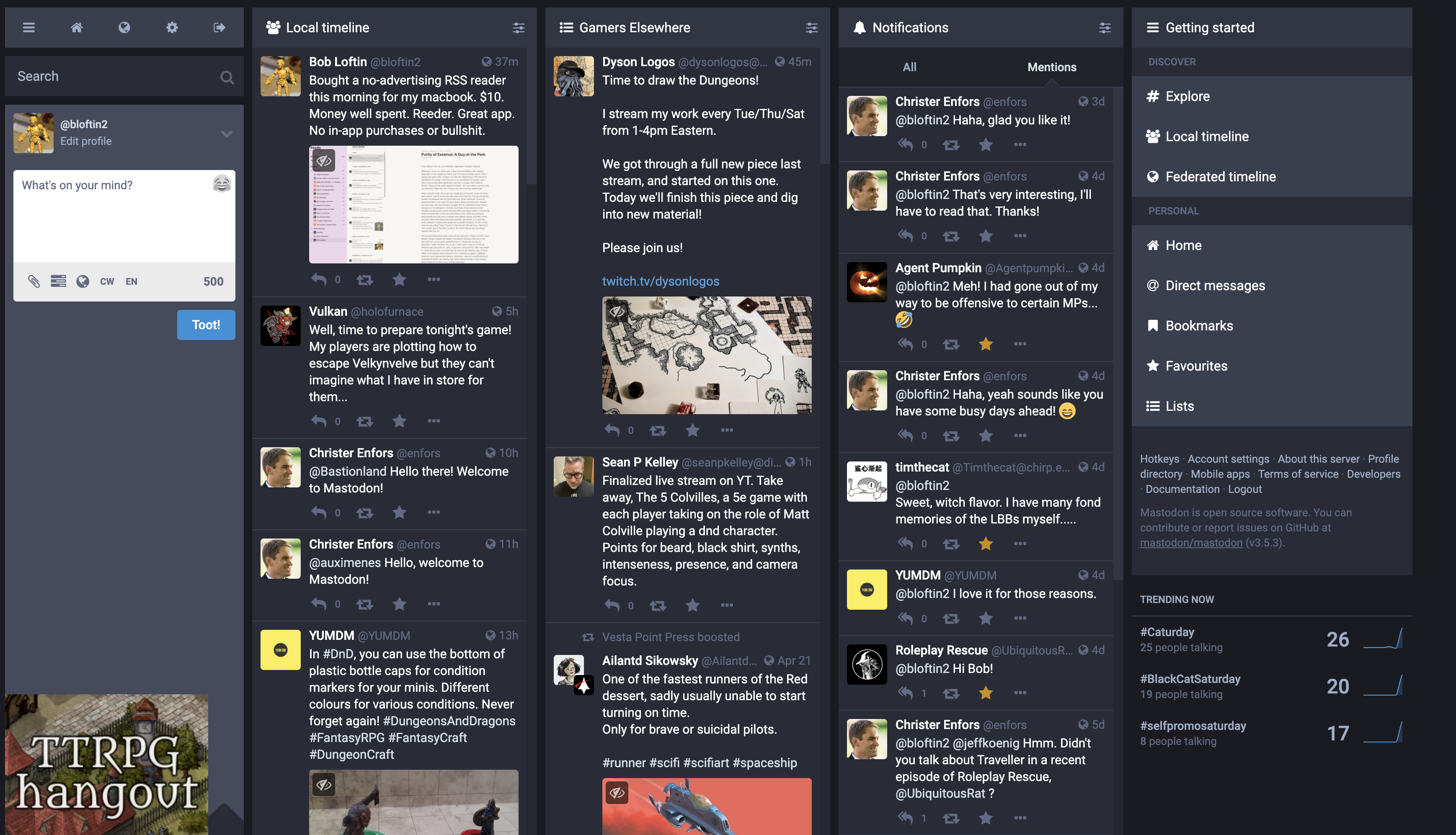
  • The web interface for Mastodon looks a lot like Tweet Deck if you switch it to the “advanced” version. You can set up columns for the post that happen locally on that server, for the people you follow, for a list of people your follow or a list based on topic. You can follow the entire universe (Fediverse) of Mastodon tweets if you want (I don’t). This allows you to curate your feed.
  • There is no algorithm in Mastodon deciding what you should see.
  • There are no suggestions of stupid shit.
  • If someone you follow boosts (retweets) stuff you don’t want to see, you can set it so that you don’t see boosts from that person.

The mobile app does not allow as much customization, but it is still better than Twitter for most of the reasons above.

Here’s a screenshot of my Mastodon page (below). I’m using it mostly to follow people in the tabletop RPG world. Those on my home server show up in the Local Timeline. Those I follow on other servers are all in a list of “Gamers Elsewhere” I created, and show up in that column. You can change the order of the columns, turn them off, etc.


Opting Out

Before Trump, Twitter was already bad. It was already a forum for harassment, bullying, propogation of stupid ideas. Trump made it worse. He makes everything worse.

Wil Wheaton is right.

But I still have some personal agency left. Tonight I’m deleting both of my Twitter accounts, and never looking at it again. Not give the morons, scumbags, and evil fucks any more of my attention. Not letting it make me worse. My job is to get better. Always better. Always aim higher.

Enthusiasm returning for MacBook

After a rocky start with my MacBook experience, my enthusiasm is returning.

My previous computer was a 1999 G4, the first one they released, running some version of the 9.X.X operating system. Of course, for at least a couple of years it has been impossible to upgrade any software on it. So its nice to have the new OS.

The MacBook is very fast, and it isn’t even the “Pro” version. I got the 2 GHz, 13″ white machine. Everything runs fast. Connecting to our Canon digital camera, the iPhoto application quickly recognized the camera and downloaded 100 images very, very fast. Faster than our Dell Inspiron laptop, and tons faster than the old G4.

On thing I really love, however, is that it boots up and shuts down really quickly.

There’s a lot of really nice, free software available on the Apple site. One of the first things I needed was a good FTP program, for transferring large files to my various sites. I downloaded and tried Transmit. Like all the other software I’ve checked out, it has a clean and elegant user interface and works like a charm. I’m also going to check out Interarchy 8.5.

For the whole tagging/social-bookmarking thing, there’s an app called Socialist that I’m going to try. There are lots of RSS readers/aggregators available.

A few words about the customer experience: Assuming you get a machine without any little problems, Apple has created a very smoooooooth customer experience with the MacBook. When you boot the machine up for the first time, it gives you a really cool looking and sounding “welcome” message, and then guides you easily through some initial setup functions, where you enter your name and other information, create an account on the computer, etc. At this point the system introduces you to the built-in camera at the top of the screen, allowing you to take your picture for your account profile.

Blended into the process is a pitch for Apple’s online services — called “.mac” .mac provides email accounts, disk backup service, remote storage space, blog/website hosting, and some other stuff. It’s actually really cool, but it does cost about $100 year, so I did not sign up. My point here is that the whole experience of starting with these computers is so warm and cozy that you almost just want to sign up.

Anyway, I’ve really just started to explore the software the system comes with. iPhoto is really cool for managing your digital images. GarageBand looks like it will be fun, but there will be a learning curve.

So as long as the MacBook keeps working correctly, I think I’m going to like it.
Blogging on the decline?

I haven’t been making a lot of posts lately, mainly because I just haven’t had that much to say. I’m trying to avoid the “what I had for lunch” type of posts.

Anyway, a coworker sent me a link to this article from Information Week, which discusses a report from the Gartner Group predicting that blogging will peak in the first half of 2007. I’m not surprised. Hell, I kept another blog for 2 years, and posted regularly, but a few months ago I decided to try to focus my efforts on specific subject areas. With concerns about online privacy growing, I think people will be less inclined to put up a lot of personal experiences, at least not without more anonymity.  There are so many other choices for online socializing too — flickr, tons of subject-specific message forums, groups, myspace — the list goes on. Then there is the fact that young people are increasingly using text messaging and other mobile technology to keep in touch rather than email and the web.

So I’ve been reading — or really just skimming — a lot of books about blogging from the last 2 or 3 years.  Seriously, I haven’t found any that were particularly interesting. The best one I’ve found is Blog!: How the Newest Media Revolution is Changing Politics, Business, and Culture. This book has interviews with a bunch of different, “sucessful” bloggers, who do lots of different kinds of blogs. Political, social, technology, personal, whatever. Nice thing about this book is you can pick the ones you are interested in, read one in 10 minutes or so, then do something else. Much like reading a blog.

Internet Librarian 2006 Notes: flickr

On day 2 of the conference, I attended a session on flickr, the photo sharing website that was acquired a while back by Yahoo!

I’ve never payed much attention to flickr. For my own personal websites I have gallery programs running on my server. Because these have proven adequate, flickr really never got my attention. But as the session started, it was made clear to me that flickr is much more than just photo sharing. It is a full blown social networking site, using images as the main content and the “draw” to get people in.

So here are a few cool things about flickr.

  1. Very easy to set up an account. In fact, if you have a Yahoo! Mail or My Yahoo! account, you already have an account on flickr. You just need to log in to finish your profile.
  2. Because of the flickr API (see more about APIs below), there are many 3rd party sites that use flickr for additional functionality. More on this in a bit — it is really cool.
  3. Users can associate tags with their photos, and the whole system is searchable by tags. Search flickr by the tag “IL2006” and you’ll see that this was a very photographed conference.
  4. flickr includes comments and comment tracking. In many pieces of social software, including this one, there is often very useful information in the comments, which are often running conversations.
  5. flickr supports “sets” of photos within an account. Very cool, and potentially useful for library images.
  6. Each image has its own URL and webpage, so you can link directly to the images.
  7. Includes RSS feeds for photo streams, so you can use RSS tools to aggregate images.
  8. Many blogging systems, including this one (Word Press) include widgets with which you can add your most recent flickr images to your page. I set this up by uploading a few photos. Really cool.

Besides people of every age and walk of life, many libraries are using flickr in various ways. Just sitting there, I began to think of potential uses for our public library, such as event photo albums, various kinds of digital photography contests and shows for our patrons, bibliographic instruction sessions on the use of flickr, etc.

OK, a bit of semi-technical info. I mentioned that flickr works well with other sites and software, enabling many 3rd party sites to use flickr’s functionality. This is due to flickr’s API, or Application Programming Interface. An API is part of an application’s code that allows it to talk to other applications. For example, it can allow flickr to exchange information, on a machine-to-machine level, with other websites. This allows the development of hybrid products, sometimes called “mashups”.

This story from the official IL2006 blog includes links to several very cool mashups using the flickr and Google APIs. By tagging your photos in flickr with specific geospatial coordinates, you can then use Google Maps to do some cool things.

My point here is that because the flickr API is available, many creative people are using flickr in ways that Yahoo! may not have anticipated. Each new application of flickr makes it more useful, drawing in additional users and increasing the database of images and the social network. And the virus spreads…

So now a little editorial. Web services like flickr are where our patrons are going on the web. A library system can spend the time and money to build its own photo gallery, but that gallery will be an isolated island on the ‘net. It is much smarter to use flickr and similar services to meet our patrons where they are. This not only allows us to interact with our patrons more effectively, but also gives us much greater flexibility, since we’re no longer married to expensive systems we’ve invested in.

Spam hits Blue Dot

The bookmark management site I discovered a few days ago — bluedot.us — has already been hit with spam. Ughhh… someone set up an account and “dotted” links to items from their adult toy shop. This is probably the biggest problem I see with social networking sites. If very strict control isn’t maintained over membership, the spammers will take over and quality will suffer. But of course, strict control over membership slows down the development of the social network, so what’s the answer?

Blue Dot

I just discovered what appears to be a new “tagging” tool for the web, Blue Dot. Its sort of like Digg.com or del.ico.us , but this one is trying to incorporate a social networking aspect in which you share your links and tags with a group of friends. Interesting. I set up an account.

We’ll see if this takes off. I haven’t have a lot of success getting myself interested in the whole tagging thing, but personalization of this tool might make it more compelling.

One interesting feature on Blue Dot is automated dotting on your personal blog. It was easy to set up my account so that anytime I post an entry here, on my Word Press blog, my Blue Dot account automatically “dots” that post, by monitoring my RSS feed. They feature this kind of support for quite a few blogging systems.

http://bluedot.us/users/bibliosk8

P.S. Man — less than 30 minutes after I made this post, it was captured by the blog search tool on Google. Scarey. The moral of the story — if you don’t want something to exist forever on the internet via Google, don’t put it up in the first place.