Category: reading

Some Reading

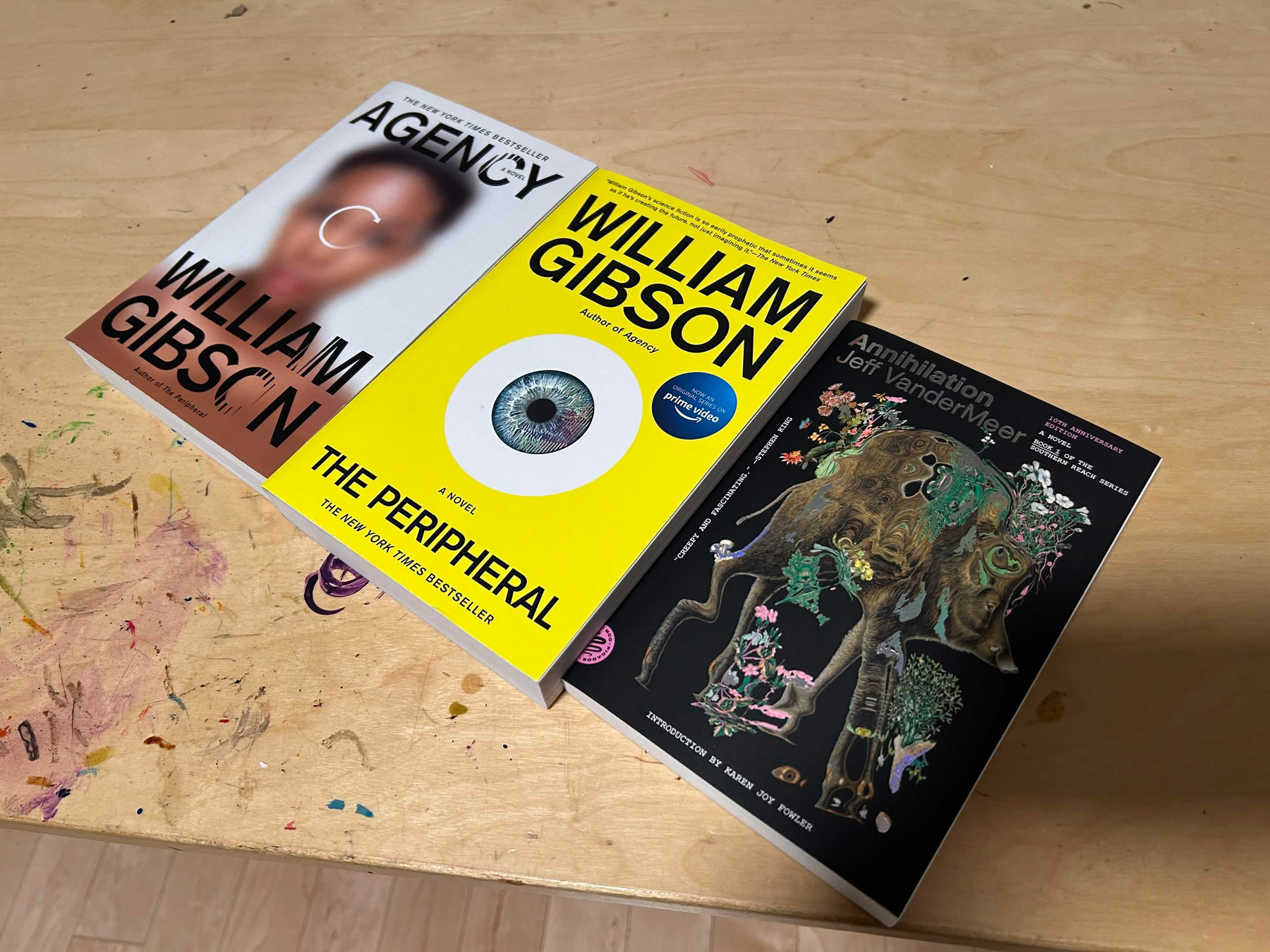
Book Cover for the novel AnnihilationA few days back I wrote this post about our trip to the bookstore, during which I bought three books.

Yesterday (Sunday) I had fished the novel I’d been reading (The Stainless Steel Rat Sings the Blues). I’ve been reading so much space opera the last few years. I love it, but I’ve been feeling like reading some other sorts of science fiction, so I grabbed the copy of Annihilation that I bought and started reading.

So, a few things…

  • After all these years of reading on a Kindle I was actually nervous about reading a physical book. That seems weird to me as I write this, but it’s true. The Kindle is so easy to read on that it feels like cheating. I was concerned that even with reading glasses my eyes would get tired, that I’d constantly lose my place on the page, that I’d miss being able to read with the lights dim.
  • Most oldschool space opera is pretty simple. The plots are simple. The prose is fairly simple. Frankly you don’t have to concentrate on them as hard as you might for something like Neuromancer, which is just more stylized, noir-style prose, that requires you to really appreciate the language and descriptions in a more intentional, patient, and thoughtful way.
  • I love space opera. I can pick up nearly any space opera novel written in the 1960s – 1980s and go to my happy place. Something like Annihilation – well – it isn’t space opera. It reminds more so far of Lovecraftian cosmic horror. So when you pick up a book that really kind of defies categories you don’t know if you’ll like it, and for me it feels like I might be wasting my time. I think that’s why series are so popular. Read the first book. If you like it, the next 3 or 4 books (or 50) will probably also be enjoyable. That’s why I love Star Wars novels. They drop you into a universe you are already familiar with, and have characters you already know.
  • I knew a little about Annihilation before I bought it. I’d seen some videos on Quinn’s Ideas about the Southern Reach series. I didn’t remember any details at all. The one thing that stuck with me from the videos was the notion of cosmic horror, but not “fun” cosmic horror like Lovecraft, but modern, disturbing, get-inside-your-head and make you feel the oppressive atmosphere cosmic horror. I’ll be honest. I feel like we have enough horror in our lives already. I don’t really want to dwell on it when I’m trying to relax with a book. And yet I did purchase this book. Maybe something “out there” was compelling me to buy it. I’m babbling. OK – simply put – I wasn’t really sure I’d enjoy reading something that isn’t a little uplifting.

Most of these concerns turned out to be unfounded. I had no trouble with my eyes, reading, or immersing myself in the story. I’m halfway through the novel at this point. It’s well-written. I did not find myself disoriented because I didn’t “know the universe” already. While it is not a happy book, and it is certainly has that Lovecraftian feel in the exploration of a super weird space and all the anxiety the comes with that, it lacks that particular quality that makes something “so dreadful it makes you sick and oppressed-feeling but you can’t put it down.

Looking forward to continuing reading Annihilation this week.
New Books and More Overthinking

The last few years I’ve been reading a lot of science fiction. Actually, that’s all I’ve been reading. It’s a long story, but boils down to “I like science fiction.”

I’ve done most of this reading on my Kindle. The Kindle has made it very easy to find a lot of hard-to-find old SF paperbacks. When I say easy, I mean you see it and click, and BOOM it is on the Kindle. I also like reading on the Kindle. It’s a very nice reading experience. Being able to control the font size not only makes it easier on my eyes, but I feel that I read more efficiently on the Kindle, as I don’t lose my place on the page so much.

In short – I like the Kindle. Yes, Amazon is a big evil company. Also yes, they made it a lot easier to live during the pandemic. Also yes, you gotta pick your battles in this life. For me that means I’m going to buy books on my Kindle, even though I “don’t really own them” because the reading experience is – just – superior for me.

HOWEVER. A Barnes & Noble bookstore opened in our neighborhood a couple of years ago, in what has been a semi-down-and-out shopping center. Seeing that space filled with a nice bookstore fills me with such hope for the future. A book store! Not a fucking vape shop or other dirtbaggery. BOOKS.

So as you might be able to tell, I support this. Would I love to have some cool independent book store in that space? Yes. Would Like a bookstore that is more likely to survive than an Indy. Also yes. Would you like me to stop doing this “also yes” thing? Probably Yes. I’ll stop.

3 books on a tableThis afternoon my wife and I went over to that store and I picked up three books. Actual physical books. It has been a while since I bought a new book. I’ve ordered some used paperbacks from Amazon. Stuff not available as eBooks. I also picked up about 10 very hard to find SF paperbacks at North Texas RPG Con at the start of June. But I feel compelled to support this neighborhood book store. Not Barnes & Noble (though I have nothing against them) but THIS book store. I want it to thrive and help impart some literacy to our neighborhood. Our public library is nearby. That is also great, and I of course love the library, being a librarian myself. But the bookstore can certainly be part of the literacy ecosystem of our area. The Infrastructure of Intelligence.

I have to admit I am conflicted about the physical books. For one thing, I have sold back a hell of a lot of books to Half Price Books over the years. I did that after years of carrying boxes of books around with us every time we moved. Now, however, we have been in our house for almost 20 years. I don’t want the house to just be full of books again, but there are worse things to fill your house with.

I have, for a long time now, thought it was kinda dumb to keep big collections of stuff around the house. Collections can get out of hand. Also, when you die, the truth is no one wants all your shit. I didn’t want all the stuff in my parents house.  At the library we get massive numbers of book donations every week, and I’d say 50% are from the collections of recently deceased people. My shit will be no different. Hell, we don’t even have kids. So maybe someone will want our very nice stereo, and maybe our music, but books? No. No one will want a mountain of science fiction novels. They just won’t.

But – I don’t care.

Because now I understand that people have always loved “artifacts” (as my wife, the historian, says). When you walk into our house and see our stereo, our music collection, and the music posters on the walls, they know a lot about who we are. And when we are in our house, that environment reminds us who we are. It makes us feel good. It is a physical manifestation of the joy we feel when we listen to our music.

When I walk into the little bedroom that is my computer room/gaming room/podcasting studio, you see science fiction posters on the wall. Actually, YOU probably don’t see them, because pretty much I am the only person other than my wife who goes in there. When I am in there, it makes me feel good. Our physical environments are important.

So if I want to have a bunch of books in there then goddammit I’m going to have books. Yes, when I’ve had a bunch of books in the past it gave me a little self-satisfaction to see all those books I’d read lined up neatly on the shelves. I’ve decided that’s fine too. I’m not going to win an award by not having things in my house that make me happy to look at. I don’t want the room to become a rats nest full of junk either, but a bookshelf or two full of books isn’t going to get me featured on a reality show about hoarding.

I’m even thinking about buying nice copies of my favorite books that I’ve read on my Kindle to have on the shelf. That might be 30 or 40 favorite books. Some non-SF ones too… On the Road. Zeitoun. William Gibson’s Sprawl trilogy. Signs Preceding the End of the World. Frankenstein. In Cold Blood. Invisible Man. The list goes on.

I’m not saying I’m abandoning the Kindle, but having the actual book has come to have value for me again.

Reading Practices

Been thinking a lot about my reading practice, and how to really “be a reader.” Here are some ideas I’ve been obsessing about. Obviously this is not an exhaustive list. Just some things I’ve been considering.

…but please, understand, this is not me urging anyone to read. If you don’t want to be a reader, or don’t care, or whatever, then don’t. You can still be a good person.

Maybe later this week I’ll write about why I read.

Here we go.

Your Self Image

I hear people say “I’m not a reader”. I think it is important not to visualize yourself as something you don’t want to be. If you think “I’m not a reader” that is not a great motivation.

Now, just saying “I’m a reader” doesn’t make you a reader, obviously, so I’m not saying you should do that. I’m saying if you would like to be a reader, don’t reinforce the opposite in your head — your self image.

Time

People often say they don’t have time. That’s almost a good excuse. The truth, however, is that nearly everyone can spend 30 minutes a day reading. If you spend 30 minutes a day reading, that’s 10,950 minutes a year. 182.5 hours per year. If it takes you, on average, 10 hours to read an entire book (I’m assuming books of reasonable length) that is 18 books per year.

Gonna be a bit harsh here. Would you rather spend that 182.5 hours of your precious and limited time on Earth dicking around on your phone? Gonna guess the answer is no.

Concentration

I know many of us feel like we have lost our ability to concentrate and focus on something like reading. Let’s face it, our society doesn’t exactly encourage focus and concentration.

Here’s the truth though. Most of us still can concentrate for a few minutes. You may need to redevelop your ability to focus on one task, but you can do it. You just need to actually do it. It’s usually a matter of priorities. So honestly, if you want to read a book, or books, or become a regular reader, you just have to start at some point, even if it is 5 minutes a day.

What does it even mean to “be a reader”?

I think it is pretty simple. It means you read books regularly. Probably almost very day. Look there will be days when you are sick or whatever and you don’t get any reading. But in general, I think to be a reader, obviously, you must actually read.

It doesn’t mean you read 100 books a year. Or 50. Or 20. It means you regularly read books, probably because you enjoy it.

Why would you even want to be a reader?

That’s a big question. For that matter, why do anything? In a relatively short time (on the cosmic time scale) we’all all be dead, the books will all be gone, etc etc…

So, I’m not going to answer that question. This stuff is for people who already want to be a reader.

LibraryThing

I’ve been using Goodreads.com for many years. I think 15 years or more. Not sure. I’ve enjoyed it. It has a lot of fun features like setting your yearly reading challenge, etc. Lots of people are on it. Lots of my friends are on it. BUT it is owned by Amazon.com, and that always leaves a bad taste in my mouth. I feel like I’m contributing to their database. Now, they are providing the service, but it’s another one of those thing where I am really the product, not the customer.

I’ve been aware of LibraryThing.com for a long time as well. I’ve investigated it in the past and found it a bit clunkier than Goodreads. As part of my never-ending quest to cut my ties with giant corporate data-mining silos I revisted LibraryThing this week and was pleased with what I saw. I was particularly delighted to fine the Who We Are page, on which we learn exactly who built it and who runs it. As it turns out, LibraryThing is run by normal people, not megacorp techbro fiends, which makes me like it even more. They used to charge a fee for full membership, but some time ago they became totally free as some of their associated software products and services began to support the whole endeavor. After reading the information on their privacy page I feel they are the side of Good, rather than Evil.

So I used the Export function in Goodreads to download my data then I imported it into LibraryThing. The first two tries I messed it up and ended up with everything in my library showing up as “currently reading”, but it offers a one-button option to delete the entire import, which I did twice before getting it right. The import worked well.

As one would expect from a company that employs librarians, LibraryThing offers a lot more options for viewing and sorting your collection.

It also offers a rich system of book discussion groups.

LibraryThing has a very different look and feel from GoodReads, but I like it.

More on Reading

I’ve been watching this video from Randy Ray this morning, What Happens if You Read for One Hour Every Day?

This is a pretty long video, but Randy really hits on some great points about the value of reading. Honestly, this is everything I’ve been thinking about for the last few  years since I began my 5% Reading Practice.

FYI: My 5% Reading Practice is simple. I read 5% of a novel every day. I read on a Kindle that track percentage completed of a book. You would obviously set a “time goal” like Randy does.

I don’t normally recommend that people spend an hour watching a YouTube video, but this one is a good use of time at 50 minutes. You could just listen to it as well. There are no real visual components you need to see.

One thing Randy talks about in this video is essentially “how do you want to spend your time.” I am about to turn 62. Do I want to spend the precious remaining healthy minutes of my life scrolling through rage-bait and bullshit on a phone? Honestly, it angers me. We often think about social media being a waste of time, but when you put it in the context of us having limited life spans, creating media to intentionally waste our lives seems to me a criminal act.

I don’t think there is any more import question than “How do I want to spend the time I have on Earth? There are questions that are perhaps equally important, but none more important.

Reading Practices, Habits, and Phones

Yesterday I was doing some research on reading. When I say “research”, I mean I was searching the internet for ideas and sort of “lay-science” stuff about reading and it’s beneficial effects on your brain and your life. Yes, as all graduates of the School of Hard Knocks say, I was “doing my research.”

Being a reference librarian, I started out searching academic databases (GASP – I just blew it! Now you know my aforementioned academic credentials are fraudulent!) I found a couple of interesting papers, but overall the research seems to concentrate on teaching kids to read and youth literacy. That is of course important work, but not my interest here. I was looking for…

  1. Evidence that reading is good for the mental and physical health of adults and methods of helping adults
  2. Methods to help adults regain their ability to concentrate enough to read novels or other long-form literature
  3. Methods, ideas, and structures for helping adults develop a regular reading practice

Sadly, a lot of the blogs I found are — you guessed it – content marketing fake blogs. Not a person actually conveying their experience or ideas, but bullshit (probably generated by AI) content marketing. Let me digress for a moment and say that anyone involved in LLMs should be taken out and maimed.

I am sad to report that in a short two-hour session of searching, the best stuff I found was on YouTube. Fuck. Good grief. On one hand it is nice to find quality stuff there, but it saddens me that the good stuff in submerged in an endless ocean of sludge. Oh well, that’s the world we live in, so put on your hazmat suit and dive right in.

I found this video by Jared Henderson, called “How to Read Better.” Jared actually has a really nice channel full of longer-form videos, and after watching this and a few other of his videos I decided to “subscribe” to his channel. Jared’s observations and opinions included some pretty obvious stuff that I think most of us know, but he articulates it well. One of the obvious but true observations is – you guessed it – the negative effects of the cell phone. There’s other stuff too. Watch the video, and maybe some of his others.

Then I found this guy, Randy Ray, and this video. Liked his videos too. His advice is pretty much the same, but the video I linked to just now talks about some of the benefits of reading. Very cool. I watched a couple of Randy’s videos, and another thing I liked was his elucidation of the idea that reading is a skill and you can get better at it. Most of us “know how to read.” Most of us are functionally literate these days. I realize I may be glossing over some populations when I say that, but that’s another matter. An important matter, but beyond what I’m talking about now. But being functionally literate doesn’t mean you read well. Reading is a skill. Or maybe a set of sub-skills really. But like most skills, the more you do it the better you get at it. So it makes sense that if you don’t read much long-form writing you may struggle at first. A lot of people say they can’t concentrate. They say they are too busy. They’d like to read but there are obstacles like these. Well, the only way to solve that problem is to start small and read. Don’t worry too much about what you are reading. Find a book that is actually of interest to you, not something you are “supposed to read.”  If you can’t concentrate, start small. Read a page without checking your goddamn phone. Is that too much? No shame. Try a paragraph. Then think about that paragraph a bit. If your concentration has been destroyed by all the distracting factors of modern life you have to rebuild it. It’s been taken from you. Get mad! Take it back!

A couple of years ago I took all the social media off my phone, but over time it insidiously wormed its way back. Last night I once again removed all social media from it. I mean ALL. It’s going to remain off my phone. If I want to participate it will be on my computer, which means I can’t compulsively check it at a stop light, in a waiting room, or while sitting in my chair trying to read. And guess what? Last night I finished the book I was reading!

Anyway, my personal reading practice, which totally fell through last year due to me spending a lot of time working on tabletop RPG stuff, is read 5% of a novel every day. Minimum. I read on a Kindle for the most part, so it tracks percent completed. To me, 5% is a very doable number for daily reading. If I’m reading a 400-page novel, that means I need to read 20 pages a day. If I read a page in 1 minute on average, that’s about 20 – 30 minutes of reading. I can do that. That means that if I stick to it I complete a book every 20 days. Normally I read more than that, but if I just read at my minimum level I feel good about my day no matter what kind of day it is.

I will say there is some super bad advice on YouTube about reading as well as these two stellar channels I’ve mentioned. I saw one guy talking about always having a pen and marking up books as you read. This is a horrible idea. HORRIBLE. Sentences have a flow. Paragraphs and pages and chapters and entire books have a flow. Even non-fiction. I can think of no better way to destroy the reading experience that obsessively taking notes while you read. Read the damned thing, and think about it, and then you can go back and make notes later. YouTubers who stress bullshit like constant note taking tend to view reading as simply extracting information from a text. It reeks of techbro optimizer douchbag culture.

You will not develop a regular practice of reading by making the experience a drag.

If you care to do so, I do think journaling about what you read can be useful. I keep a blog about my science fiction reading. It’s fun. I don’t dig into a ton of details. I just write what I think about a book. Sometimes I just note that I began it and finished it. Sometimes more. It is a nice chance to take a little time and reflect on what you just read. I think that’s a good thing.

Well, this has been kind of an all over the place screed, I know. Need to get it off my chest and share some good videos.